Why Industrial, Vehicle-Mounted, and Outdoor Displays Need Optical Bonding
Updated: Aug 6

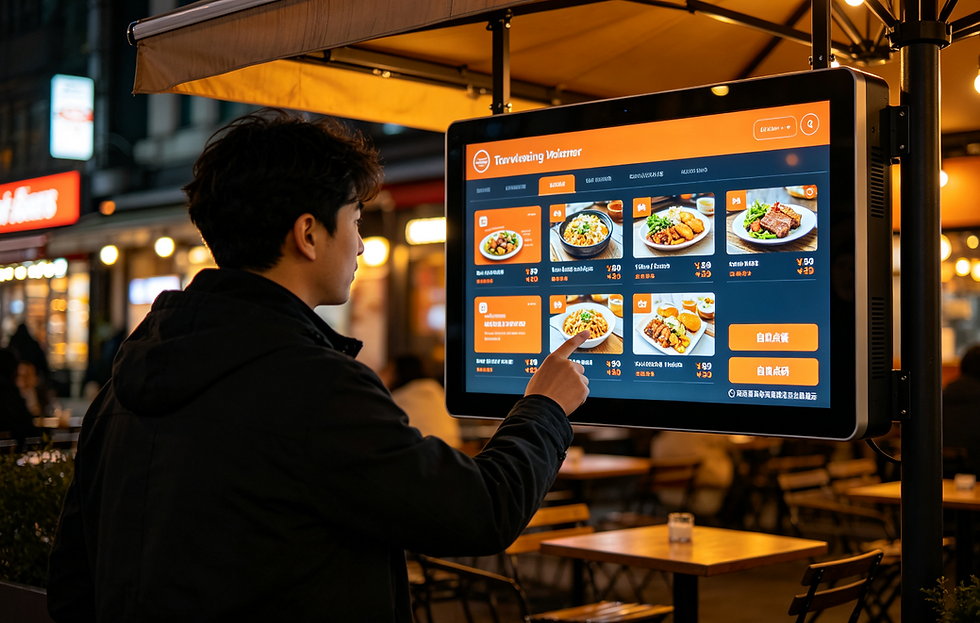
In applications such as industrial control, vehicle-mounted displays, outdoor high-brightness screens, self-service terminals, and agricultural machinery, standard air-bonded displays often face problems such as glare, reflection, dust intrusion, internal fogging, inaccurate touch response, structural looseness after vibration, and unstable performance under high or low temperatures.
For industrial equipment that must operate reliably over long periods, the display is not just a screen. It is a key interface for operation, machine status monitoring, and human-machine interaction. In harsh environments with direct sunlight, temperature changes, vibration, dust, and humidity, more equipment manufacturers choose optical bonding to improve the reliability and usability of touchscreen display modules.
What Is Optical Bonding?
Optical bonding is a process that uses OCA optical adhesive or OCR/LOCA liquid optical adhesive to bond the cover glass, touch sensor, and LCD panel together without an air gap.
Compared with traditional frame bonding or air bonding, optical bonding reduces internal reflection, improves light transmission and contrast, strengthens the overall structure, and helps prevent dust and moisture from entering the display layers. This reduces the risk of fogging, dust accumulation, delamination, and touch drift.
Ever Glory’s TouchPro optical bonding touchscreen display solutions can be used in industrial control, vehicle-mounted displays, outdoor high-brightness equipment, medical terminals, marine systems, self-service terminals, EV charging stations, and agricultural machinery. The solution supports customized display sizes, touch structures, cover glass thickness, surface treatments, and wide-temperature requirements.
Why Do Industrial, Vehicle-Mounted, and Outdoor Displays Need Optical Bonding?
1. Better Sunlight Readability
Outdoor EV chargers, construction machinery, agricultural machinery, and vehicle control panels are often exposed to strong sunlight. Standard air-bonded displays can easily suffer from reflection and washed-out images, making the interface difficult to read.
Optical bonding removes the air gap and reduces internal reflection, helping the screen maintain better contrast and clarity under sunlight. This is especially important for outdoor high-brightness displays, self-service terminals, and vehicle-mounted control panels.
2. Prevention of Dust, Fogging, and Condensation
Traditional frame-bonded structures leave an air gap between the layers. Over long-term use, dust and moisture may enter the gap, especially in outdoor, humid, low-temperature, or high-temperature-difference environments.
A fully bonded structure combines the display layer and touch layer more tightly, reducing the risk of moisture and dust entering the internal layers. This makes optical bonding more suitable for EV charging stations, marine equipment, fuel station terminals, agricultural machinery, and industrial field equipment.
3. Higher Vibration and Impact Resistance
Vehicle-mounted devices, construction machinery, agricultural machinery, and industrial control systems often face continuous vibration, impact, and complex operating conditions. Air-bonded displays are more likely to suffer from structural looseness, display instability, or unstable touch response after long-term vibration.
With optical bonding, the cover glass, touch sensor, and display panel form a stronger integrated structure. This helps improve vibration resistance, impact resistance, and breakage protection, making the display more suitable for vehicle, industrial, outdoor, and machinery integration.
4. More Accurate and Stable Touch Performance
In industrial control and outdoor terminals, touch response must be stable and accurate. Standard bonding methods may cause touch drift, delay, or false touch due to air gaps, signal interference, or environmental changes.
Optical bonding reduces interference between layers and helps maintain stable touch signal transmission. Combined with industrial-grade PCAP capacitive touch technology, it can also support glove operation, waterproof touch, and stable interaction in demanding environments.
5. Better High and Low Temperature Reliability
Industrial, vehicle-mounted, and outdoor equipment often needs to operate under high temperatures, low temperatures, or frequent temperature changes. If the adhesive material or bonding process is not well controlled, the screen may develop bubbles, delamination, yellowing, or fogging.
Ever Glory can select OCA, OCR, or LOCA bonding solutions according to project requirements and combine them with high-brightness displays, cover glass structure, and reliability testing requirements to improve stability in wide-temperature environments.
Application Scenarios
Optical bonding touchscreen display solutions are suitable for:
Vehicle-mounted displays
Industrial control equipment
Outdoor high-brightness displays
EV charging stations
Medical devices
Marine displays
Security monitoring terminals
Self-service ticketing kiosks
Self-service ordering kiosks
Self-checkout kiosks
Agricultural machinery
Construction machinery
For these applications, customers usually care about more than screen size and brightness. Long-term stability, protection level, touch reliability, structural strength, installation method, and maintenance cost are also key decision factors.
Core Advantages of TouchPro Optical Bonding Solutions
Ever Glory’s TouchPro optical bonding touchscreen display solutions can support:
OCA / OCR / LOCA optical bonding
G+G / G+FF touch structure
Industrial-grade PCAP capacitive touch
Customized sizes from 5 to 86 inches
High-brightness outdoor display options
AG anti-glare treatment
AR anti-reflective treatment
AF anti-fingerprint treatment
7H-8H strengthened glass
Customized thick cover glass
Waterproof, dustproof, and salt spray resistant design
Wide-temperature operation
Glove touch support
Vibration and impact resistant structure design
These capabilities help equipment manufacturers choose a more suitable touchscreen display module for each application, instead of relying only on standard display solutions.
Optical Bonding vs. Traditional Frame Bonding
Comparison Item | Optical Bonding | Frame Bonding / Air Bonding |
Layer Structure | No obvious air gap | Air gap exists |
Sunlight Readability | Better, lower reflection | Easy to reflect and wash out |
Dust and Fog Prevention | Better | Easier to collect dust and fog |
Vibration Resistance | Stronger | Weaker |
Touch Stability | More stable | More affected by environment |
Cost | Higher | Lower |
Suitable Applications | Industrial, vehicle, outdoor, medical, marine | General indoor equipment |
If the product is used in a low-intensity indoor environment, frame bonding may offer a cost advantage. However, if the equipment needs to operate outdoors, in vehicles, on industrial sites, or in humid and dusty environments, optical bonding is usually the better choice.
Key Parameters When Selecting an Optical Bonding Solution
Parameter | What to Check |
Bonding Method | OCA, OCR, or LOCA |
Display Size | Whether the required size and structure can be supported |
Touch Structure | G+G, G+FF, PCAP, etc. |
Brightness Requirement | Whether outdoor high brightness is required |
Operating Temperature | Whether -30°C to 70°C or -40°C to 85°C is required |
Cover Glass Thickness | Whether thick glass, anti-impact, or protective glass is needed |
Surface Treatment | AG, AR, AF, anti-glare, anti-fingerprint |
Protection Requirement | Waterproof, dustproof, salt spray resistance |
Reliability Testing | High-low temperature, damp heat, vibration, drop testing |
Installation Method | Embedded, panel mount, open frame module, etc. |
Common Problems and Risks
1. Bubbles or Delamination
If the adhesive material is poor or the bonding, curing, and bubble removal process is not well controlled, bubbles or delamination may occur after high-low temperature cycling.
2. Fogging Under Temperature Changes
Poor sealing or remaining air gaps may allow moisture to enter the layers, causing internal fogging or condensation.
3. Glue Overflow and Contamination
OCR/LOCA bonding requires precise control of glue amount, curing time, and production environment. Poor process control may affect appearance and touch performance.
4. Higher Repair Cost
Optically bonded modules have a more integrated structure. If the screen is seriously damaged, the entire module usually needs to be replaced. Therefore, structural protection, cover glass strength, and replacement strategy should be considered during the project development stage.
FAQ
Q1: Can an optically bonded display be repaired if it is damaged?
In most cases, an optically bonded touchscreen display module needs to be replaced as a complete unit. Ever Glory can provide structural suggestions during the project development stage to help reduce future maintenance and replacement costs.
Q2: Is optical bonding always more expensive than frame bonding?
The initial cost of optical bonding is usually higher than frame bonding. However, it can improve sunlight readability, reduce fogging and dust intrusion, improve vibration resistance, and maintain better touch stability. For outdoor, vehicle-mounted, and industrial equipment, long-term failure rate and maintenance cost are often more important than initial cost alone.
Q3: Which products are more suitable for optical bonding?
Outdoor EV chargers, vehicle-mounted displays, agricultural machinery, construction machinery, industrial control panels, medical equipment, marine displays, and self-service terminals are all suitable for optical bonding touchscreen display solutions.
Q4: What sizes can Ever Glory support?
Ever Glory can provide multi-size TouchPro touchscreen display module solutions, covering small industrial displays to large outdoor display modules. The final solution depends on project requirements such as size, brightness, cover glass, structure, and reliability targets.
Conclusion
For industrial control, vehicle-mounted control panels, outdoor high-brightness displays, and self-service terminal equipment, the value of a touchscreen display is not only to show information. It must also provide clear, stable, and reliable human-machine interaction in complex environments.
Optical bonding can effectively solve problems such as reflection, glare, dust intrusion, internal fogging, inaccurate touch response, vibration impact, and high-low temperature instability. Based on TouchPro industrial touchscreen display solutions, Ever Glory can provide reliable and customizable optically bonded touchscreen display modules for different equipment manufacturers.