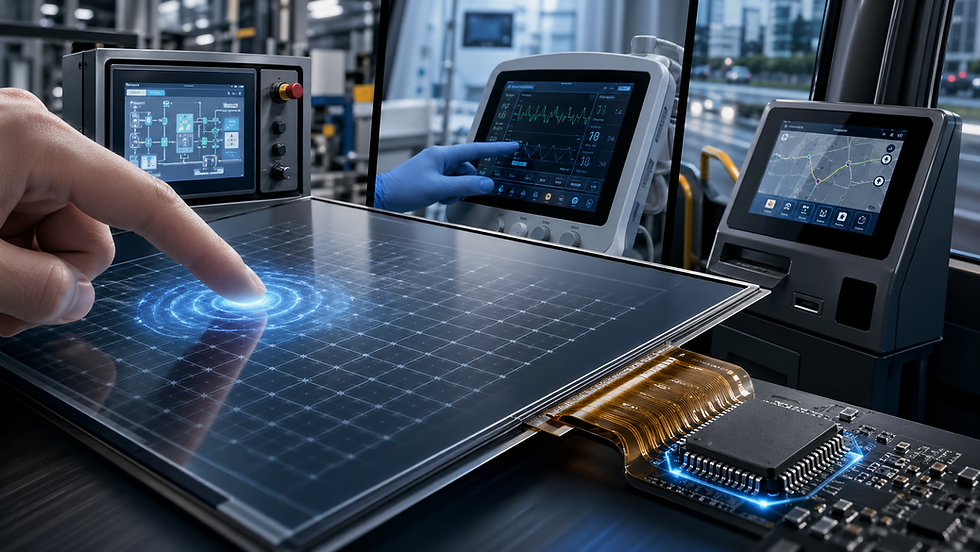
What is the opposite of a capacitive touch screen?
- Oct 20, 2025
- 4 min read

When we talk about the "opposite" of a capacitive touch screen in the world of touch technology, we are primarily referring to a Resistive Touch Screen. While other technologies like infrared or surface acoustic wave exist, resistive technology stands as the most fundamental and direct counterpart to capacitive, differing in almost every conceivable way—from its basic working principle to its ideal applications.
The table below provides a clear, high-level comparison of these two opposing technologies:
Feature | Capacitive Touch Screen | Resistive Touch Screen (The "Opposite") |
Working Principle | Detects the electrical charge from a finger. | Detects physical pressure applied to the screen. |
Input Method | Best with a finger (bare skin). | Works with any object: finger (gloved or bare), stylus, pen. |
Screen Construction | Single, durable glass layer with a conductive coating. | Multiple flexible layers (usually two), with an air gap in between. |
Touch Sensitivity | Highly sensitive, supports multi-touch gestures (pinch, zoom). | Less sensitive, requires firm press; primarily single-touch. |
Image Clarity | Excellent, as the glass is highly transparent. | Good, but layers can reduce clarity and brightness. |
Durability | Resistant to surface contaminants (dust, water). The glass can crack if impacted. | The flexible top layer is prone to scratches but is hard to shatter. |
Cost | Generally more expensive to manufacture. | Very low-cost and economical. |
A Deep Dive into the Resistive Touch Screen
To truly understand why it's the opposite, let's explore how a resistive touch screen works and its key characteristics.
1. The Core Working Principle: Pressure, Not Electricity
A resistive screen is a "passive" technology. It does not sense electrical properties but rather physical force. It is typically composed of two thin, flexible, transparent sheets:
A top layer made of flexible plastic (usually Polyethylene Terephthalate or PET).
A bottom layer made of rigid glass or plastic.
Both layers are coated with a thin, transparent conductive material (like Indium Tin Oxide or ITO) and are separated by tiny, invisible spacer dots to keep them apart until touched.
When you press on the top layer, it flexes and makes contact with the bottom layer at the specific point of pressure. The controller then detects this contact and measures the change in electrical current as a voltage drop, precisely calculating the (X,Y) coordinate of the touch.
This fundamental principle is the complete opposite of a capacitive screen, which relies on the disturbance of an electrostatic field and requires no physical pressure whatsoever.
2. Key Characteristics and Disadvantages (from a Modern User's Perspective)
While incredibly useful in specific contexts, resistive technology has several disadvantages, especially when compared to the smooth, intuitive experience of capacitive screens:
Requires Firm Pressure: You can't just lightly brush a resistive screen; you must press down firmly enough to make the two layers connect. This makes it less ideal for fast, fluid interactions.
No True Multi-Touch: The fundamental design of a basic resistive screen makes it incapable of reliably detecting more than one touch point at a time. You cannot perform two-finger gestures like pinch-to-zoom.
Reduced Optical Clarity: The multiple layers and the flexible nature of the top plastic sheet can lead to increased screen glare, lower brightness, and a slightly "hazy" image compared to the single glass layer of a capacitive screen.
Less Durable Over Time: The flexible top layer is susceptible to scratches from sharp styli or fingernails. After millions of presses, the layers can wear out, leading to a loss of sensitivity or accuracy in certain spots.
Susceptible to Damage from Sharp Objects: While the plastic top layer is hard to shatter, it can be punctured.
Are There Other "Opposites"?
While resistive is the primary and most common opposite, other technologies also contrast with capacitive screens in specific ways:
Infrared (IR) Grid: Instead of a solid surface, IR screens have a frame that creates an invisible grid of infrared light beams across the front of the screen. A touch is registered when a finger (or any object) interrupts these beams. It's "opposite" in the sense that there is no overlay on the screen at all, making it highly durable for large-format displays like kiosks and whiteboards.
Surface Acoustic Wave (SAW): This technology uses ultrasonic waves passing over the surface of the screen. A touch absorbs some of this wave, registering the input. It offers excellent image clarity (like capacitive) but can be disrupted by contaminants like dirt or water droplets on the screen.
Conclusion: It's About the Right Tool for the Job
Labeling resistive touch screens as "inferior" is a mistake; they are simply different. They were the dominant technology before capacitive took over for consumer devices like smartphones and tablets. Today, the "opposite" technology of capacitive screens finds its strength in niches where its "disadvantages" become advantages:
Industrial Controls: Factories where operators wear gloves.
Medical Equipment: Hospitals requiring sterile, gloved use and the precision of a stylus.
Older ATMs & Kiosks: Where a firm, deliberate press is preferred.
Low-Cost Devices: Where budget is the primary concern.
Restaurant POS Systems: Often used with a sturdy stylus for rapid input.
In summary, if you are looking for the true technological and operational opposite of a sleek, modern capacitive screen, you are looking for the Resistive Touch Screen—a pressure-based, versatile, and economical workhorse that continues to thrive in environments where capacitive screens would fail.