Standard LCD to High-Brightness LCD Conversion: Engineering Guide for Outdoor Readability
Converting a standard-brightness LCD into a high-brightness LCD is not a simple software adjustment. It is a system-level engineering process that usually involves upgrading the backlight unit, optimizing the optical structure, improving thermal management, and verifying power compatibility.
Many users assume that a normal LCD can become sunlight-readable by increasing software brightness or changing display settings. In reality, the maximum brightness of an LCD is mainly determined by the backlight system behind the panel. The LCD cell forms the image, but it does not generate light by itself. That is why most high-brightness conversion projects focus on backlight redesign, not just screen settings.
A standard LCD typically operates in the range of 200 to 350 nits, which is usually sufficient for indoor use. A high-brightness LCD often starts from 800 nits and may reach 1000, 1500, or even higher, depending on the display size, thermal capacity, and application environment.
For outdoor kiosks, vehicle-mounted displays, industrial handheld terminals, fuel station screens, public information terminals, and other high-ambient-light equipment, upgrading a standard LCD to a high-brightness solution can improve visibility while avoiding the cost and complexity of a full display redesign.
Why Outdoor and High-Ambient-Light Applications Need High-Brightness Displays
A standard LCD that looks acceptable indoors may become difficult or impossible to read under strong ambient light. In outdoor use, reflected sunlight can overpower the displayed image, making the screen appear washed out, gray, or nearly unreadable.
This becomes a serious problem in applications such as:
Outdoor self-service kiosks
Vehicle-mounted terminals
Fuel dispenser displays
Industrial outdoor control panels
Field inspection devices
Public service terminals
Construction and logistics equipment
Outdoor monitoring systems
In these environments, operators need to read data, instructions, warnings, or transaction details quickly and accurately. Poor readability reduces usability and may create operational risk.
A complete replacement with a new sunlight-readable module is one option, but it is often expensive. If the original LCD, housing, and system interface are still usable, a high-brightness conversion can be a practical engineering solution.
Suggested Visual Aid – Figure 1Outdoor readability comparison: standard-brightness LCD vs converted high-brightness LCD under sunlightThis visual is best inserted here because it immediately shows the practical value of the conversion.
Suggested Figure Caption:Figure 1. Outdoor readability comparison between a standard LCD and a converted high-brightness LCD under direct sunlight.

What a High-Brightness LCD Conversion Really Involves
A true high-brightness conversion is much more than replacing a few LEDs. It usually requires coordinated work across several engineering areas:
Backlight module redesign
LED driver matching
Optical film optimization
Light guide or diffuser redesign
Thermal path improvement
Power supply verification
Mechanical clearance review
Brightness uniformity validation
Outdoor readability optimization
This is why a standard LCD to high-brightness conversion should be treated as a complete display engineering project, not as a basic modification.
Key Parameters to Evaluate Before Conversion
1. LCD Thickness and Internal Space
The thickness of the LCD module directly affects whether a stronger backlight structure can be installed.
A thicker module usually gives more room for:
Higher-power LEDs
Diffuser plates
Optical films
Aluminum heat spreaders
Backlight driver modifications
A very thin LCD may not have enough space for a direct-lit backlight or larger thermal components. Forced modification can lead to pressure marks, light leakage, uneven brightness, or even permanent panel damage.
Before starting the project, engineers should measure:
LCD thickness
Backlight cavity depth
Internal frame clearance
Cable routing path
Heat sink installation space
Mechanical interference risk
2. Target Brightness Level
The required brightness should be selected according to the real operating environment.
Application Environment | Typical Brightness Range |
Indoor / controlled lighting | 250–500 nits |
Semi-outdoor / shaded area | 600–1000 nits |
Outdoor bright environment | 1000–1500 nits |
Direct sunlight / harsh outdoor use | 1500 nits or higher |
A higher number is not always better. Increased brightness also brings:
Higher power consumption
More heat generation
Greater driver load
Higher system stress
For outdoor readability, brightness must be evaluated together with surface reflection, contrast, anti-glare treatment, anti-reflective coating, and optical bonding.
3. Backlight Structure
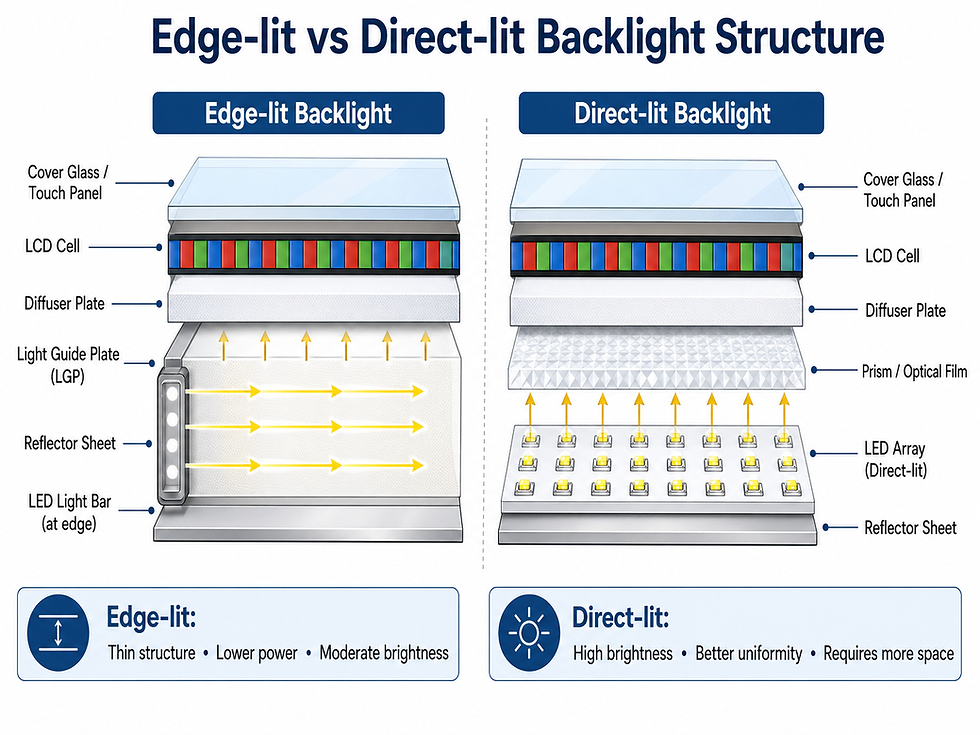
The backlight is the core of the conversion. In practice, two common structures are used: edge-lit and direct-lit.
Edge-Lit Backlight
In an edge-lit design, LEDs are arranged along one or more edges of the light guide plate. This structure is thin and efficient, making it suitable for compact displays and limited-space applications.
Advantages of edge-lit designs:
Thin structure
Lower power consumption
Easier to fit into compact modules
Suitable for moderate brightness upgrades
Limitations of edge-lit designs:
Limited maximum brightness
More difficult heat concentration control
Potential edge light non-uniformity
Less suitable for very high outdoor brightness targets
Direct-Lit Backlight
In a direct-lit design, LEDs are distributed behind the LCD panel and emit light more directly toward the display area. This structure can achieve higher brightness and better uniformity when designed correctly.
Advantages of direct-lit designs:
Higher brightness potential
Better uniformity
Better scalability for industrial outdoor use
More suitable for 1000 nits and above
Limitations of direct-lit designs:
Requires more internal space
More heat generation
Stronger thermal design needed
Higher power demand
More complex mechanical integration
Suggested Visual Aid – Figure 2Cross-sectional comparison of edge-lit and direct-lit backlight structuresInsert this figure here to help readers understand the internal design difference.
Suggested Figure Caption:Figure 2. Cross-sectional comparison of edge-lit and direct-lit backlight structures used in high-brightness LCD conversion.
4. Thermal Management
Thermal management is one of the most critical parts of a high-brightness LCD conversion. When brightness increases, LED power rises, and more heat is generated inside the display system.
If heat is not removed effectively, the display may suffer from:
Brightness decay
Color shift
Optical film deformation
LED aging
Driver instability
Local hot spots
Shortened service life
LCD blackening
LCD blackening is often related to the liquid crystal material approaching its isotropic transition temperature, which is typically in the range of 70°C to 100°C, depending on the LC formulation and panel design. When this happens, the liquid crystal can temporarily lose its normal electro-optical behavior, causing the image to appear dark, washed out, or locally blackened.
In real products, however, visible degradation may begin even earlier. Local hot spots, polarizer stress, adhesive aging, and backlight heat buildup may affect image quality before the LC material fully reaches its isotropic point.
For this reason, a reliable high-brightness conversion should not only target the required luminance level, but also ensure that the LCD, backlight, driver electronics, and enclosure remain within a safe thermal range under worst-case ambient conditions.
In engineering practice, the thermal target should always stay comfortably below the material limit, with a sufficient safety margin for:
High ambient temperature
Sealed housing conditions
Continuous operation
Poor ventilation environments
A robust design may require:
Aluminum heat sinks
Heat spreaders
Thermal pads
Metal housing conduction
Thermal simulation
Long-duration burn-in testing
5. Power Compatibility
A high-brightness backlight consumes more power than a standard one. Before modification, engineers must verify whether the original power system can support the new load.
Power evaluation should include:
LED string voltage
Rated current
Peak current
Driver capacity
Power supply margin
Connector current rating
Startup behavior
Dimming compatibility
Overcurrent and overvoltage protection
If the power supply is not sufficient, the display may show flicker, unstable brightness, startup failure, or overheating.
6. Brightness Uniformity
A display is not truly usable if its center is bright but its edges are dark. Uniformity is essential, especially for industrial, transportation, and public-use displays that show data, alarms, maps, or status information.
Poor uniformity can result from:
Improper LED placement
Inadequate diffuser design
Misaligned optical films
Mechanical pressure on the backlight
Low-quality LED binning
Thermal deformation
Uniformity should always be verified after conversion.
7. Surface Reflection and Outdoor Readability
Brightness alone does not guarantee sunlight readability. If the screen surface reflects too much light, even a bright display may remain difficult to read.
Outdoor readability is usually improved by combining high brightness with:
AG anti-glare treatment
AR anti-reflective coating
Optical bonding
High-transmission cover glass
Proper surface finishing
Reduced internal reflection
This is especially important for outdoor touch displays, where the full optical stack may include:
LCD panel
Backlight
Cover glass
Air gap or bonding layer
Surface coating
Brightness Enhancement Film vs Direct-Lit Backlight Upgrade
Two common strategies are used in standard LCD to high-brightness conversion: brightness enhancement film (BEF) and direct-lit backlight upgrade.
Option A: Brightness Enhancement Film (BEF)
BEF is an optical film designed to redirect light toward the front viewing direction. It improves on-axis brightness by reducing sideward light loss.
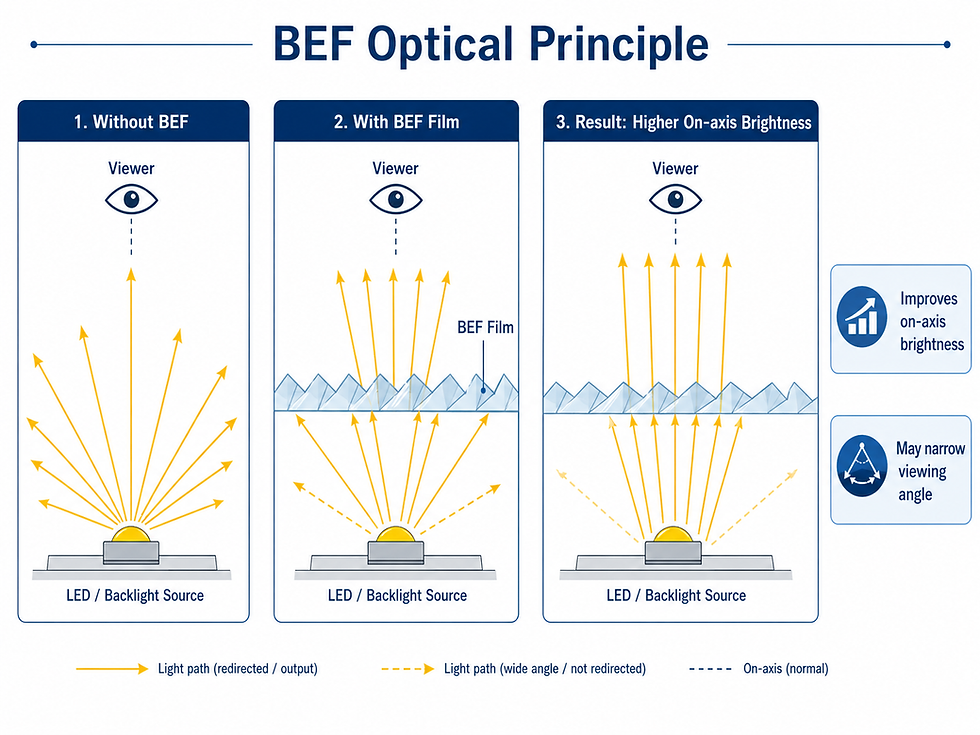
This is a relatively light optical upgrade because it improves efficiency without fundamentally increasing backlight power.
Advantages of BEF:
Lower cost
Easier implementation
Smaller thermal impact
Suitable for semi-outdoor use
Useful when space is limited
Limitations of BEF:
Limited brightness gain
Cannot replace a weak backlight
May narrow the viewing angle
Not enough for strong direct sunlight
Performance depends on precise film alignment
Suggested Visual Aid – Figure 3BEF optical principle diagram showing how light is redirected toward the front viewing angleInsert this figure here to help readers understand why BEF improves center brightness but may affect viewing angle.
Suggested Figure Caption:Figure 3. Principle of brightness enhancement film (BEF): redirecting light toward the front viewing direction to improve on-axis brightness.
Option B: Direct-Lit High-Brightness Backlight
A direct-lit high-brightness conversion replaces the original backlight with a stronger LED-based structure behind the LCD panel.
This is a deeper engineering modification, but it provides a much stronger brightness upgrade.
Advantages of a direct-lit upgrade:
Much higher brightness potential
Better outdoor readability
Better uniformity potential
More suitable for industrial outdoor equipment
Better for 1000–1500 nits and above
Limitations of a direct-lit upgrade:
Higher cost
Higher power consumption
Greater heat generation
More complex installation
Requires stronger thermal and electrical design
Comparison: BEF Upgrade vs Direct-Lit Upgrade
Item | BEF Upgrade | Direct-Lit Upgrade |
Main principle | Redirects light forward | Replaces backlight with stronger LED structure |
Modification depth | Light optical optimization | Core hardware redesign |
Brightness improvement | Moderate | Significant |
Power consumption | Low impact | Higher |
Thermal challenge | Lower | Higher |
Mechanical impact | Small | Medium to high |
Cost | Lower | Higher |
Best for | Semi-outdoor / moderate improvement | Outdoor sunlight / industrial use |
Common Problems in High-Brightness LCD Conversion
1. Poor Heat Dissipation
This is the most common and most serious risk. If heat is not managed properly, the LCD, LEDs, driver, and optical materials may degrade quickly.
2. Mechanical Interference
A new backlight may not fit the original structure. This can cause assembly failure, pressure marks, or screen damage.
3. Poor Uniformity
Bright spots, dark corners, or visible LED patterns reduce usability and visual quality.
4. Power Instability
If the power system cannot support the new load, flicker or startup failure may occur.
5. Reflection Not Solved
A display may become brighter but still remain difficult to read outdoors if reflection control is not addressed.
Recommended Configuration Strategies
Semi-Outdoor / Budget-Conscious Solution
Suitable for shaded outdoor areas, semi-outdoor kiosks, and limited-budget upgrades.
Recommended configuration:
600–1000 nit target
Edge-lit structure
BEF optical film
Basic heat spreader
Power verification
Optional AG surface treatment
Outdoor High-Brightness Solution
Suitable for fuel stations, vehicle terminals, outdoor kiosks, industrial field equipment, and strong-light environments.
Recommended configuration:
1200–1500 nits or higher
Direct-lit backlight
High-efficiency LED array
Strong heat sink design
Upgraded LED driver
Stable power supply
AG / AR treatment
Optional optical bonding
Dust and water protection design
Thin LCD Module Solution
If the original module is too thin for a full direct-lit structure, a lighter solution may be more practical.
Recommended configuration:
High-efficiency edge-lit LED strip
Optimized light guide plate
BEF or DBEF film
Compact heat spreader
600–800 nit practical target
Strict mechanical and thermal validation
Engineering Validation Checklist
Before converting a standard LCD to a high-brightness display, engineers should verify:
LCD thickness and available clearance
Target brightness requirement
Backlight structure selection
Driver compatibility
Power supply margin
Thermal path effectiveness
Brightness uniformity
Surface reflection control
Optical film alignment
Housing and sealing design
Long-term aging performance
A high-brightness LCD conversion should never be treated as a simple component swap.
FAQ
Q1: Will the display resolution change after conversion?
No. The LCD pixel structure remains the same, so the resolution does not change. However, readability can improve significantly if the backlight and optical system are properly upgraded.
Q2: Will power consumption increase?
Usually yes, especially with a direct-lit high-brightness upgrade. BEF-based improvement may have a smaller power impact because it improves optical efficiency rather than relying mainly on higher LED power.
Q3: Can a standard LCD always be converted?
No. Some LCDs do not have enough internal space, thermal margin, or power capacity for reliable modification. A feasibility assessment is necessary before conversion.
Q4: Will the upgrade shorten display lifetime?
Not necessarily. If the design uses proper current control, quality LEDs, effective heat dissipation, and safe operating margins, the display can maintain good long-term reliability. Poor thermal design is what usually shortens lifetime.
Q5: Is brightness alone enough for sunlight readability?
No. Real outdoor readability depends on brightness, reflection control, contrast, optical bonding, and surface treatment working together.
Final Thoughts
Converting a standard LCD into a high-brightness LCD can be an effective way to improve outdoor visibility and extend the value of existing equipment. But the success of the project depends on much more than simply making the screen brighter.
A reliable conversion requires coordinated engineering across:
Backlight design
Optical efficiency
Thermal management
Power compatibility
Mechanical integration
Reflection control
Reliability validation
BEF-based enhancement is suitable for moderate improvement and semi-outdoor applications, while direct-lit high-brightness backlight conversion is the more robust solution for sunlight-readable industrial and outdoor equipment.
For companies developing outdoor terminals, vehicle-mounted systems, industrial field displays, fuel station equipment, or public information devices, a properly engineered high-brightness conversion can improve usability without requiring a full system redesign.
touchpro provides project-based evaluation and customization support for high-brightness LCD conversion. Our engineering team can assess the original LCD structure, backlight feasibility, thermal path, optical stack, power system, and outdoor readability requirements to help develop a practical and reliable solution.
Need to Upgrade a Standard LCD for Outdoor Readability?
Contact the touchpro engineering team for a feasibility assessment of your LCD high-brightness conversion project. Our engineers can help evaluate:
Backlight structure
Brightness target
Thermal design
Power compatibility
Optical film selection
AG / AR requirements
Mechanical fit
Production feasibility
Whether the project involves an outdoor kiosk, vehicle-mounted terminal, fuel station display, industrial handheld device, or field-use monitor, touchpro can help determine the most practical path from standard brightness to reliable outdoor readability.


